Molecule Profile
Ethane-1,2-dithiol · EDT · CAS 540-63-6
C₂H₆S₂ · MW 94.19 g/mol
Identifiers
| Identifier | Value |
|---|---|
| IUPAC Name | Ethane-1,2-dithiol |
| Synonyms | 1,2-Ethanedithiol; Ethylene dithiol; 1,2-Dimercaptoethane; Dithioglycol; EDT; Ethylene mercaptan; 2-Mercaptoethanethiol |
| CAS Number | 540-63-6 |
| EC Number | 208-752-3 |
| Beilstein (BRN) | 505946 |
| SMILES | SCCS |
| InChI | InChI=1S/C2H6S2/c3-1-2-4/h3-4H,1-2H2 |
| Molecular Formula | C₂H₆S₂ |
| Molecular Weight | 94.19 g/mol |
| FEMA Number | 3484 |
Source: PubChem; NIST Chemistry WebBook (2024).
Molecular Structure
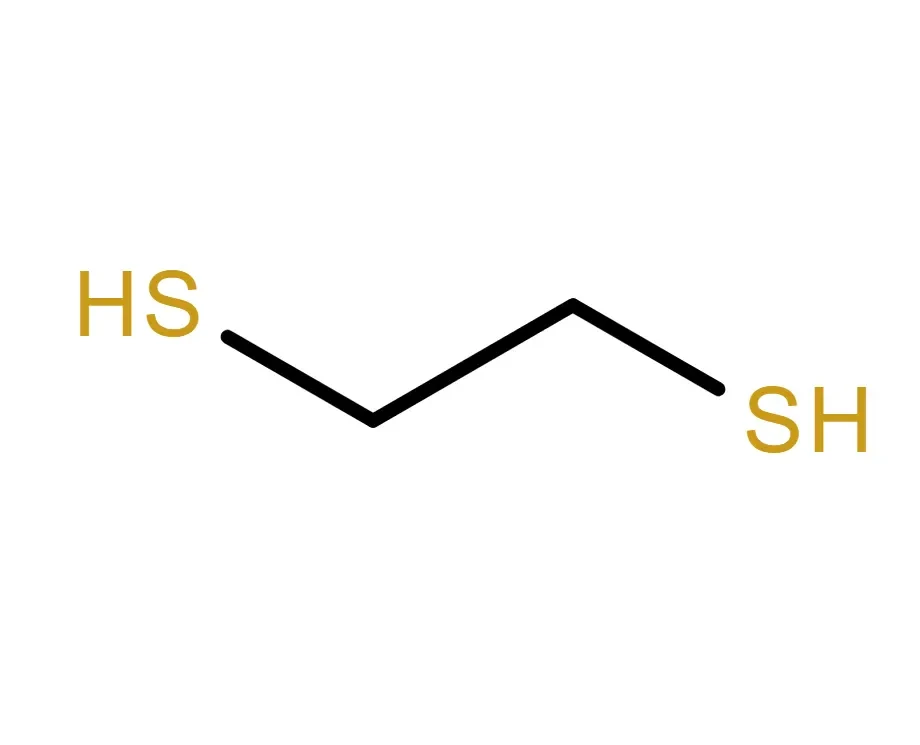
EDT consists of a two-carbon backbone terminated by thiol groups at each end. Rotation about the central C–C bond gives two principal conformations: the anti form, in which the sulfur atoms are opposed, and the gauche form, in which they are approximately syn-periplanar. The anti conformer is the more stable by roughly 3.8 kJ/mol in the gas phase.
The gauche conformer is significant in coordination chemistry because the two sulfur donors are pre-organised for chelation. Key bond lengths and angles are summarised below.
| Parameter | Value | Unit | Source |
|---|---|---|---|
| C–S bond length | 1.81 | Å | NIST WebBook |
| S–H bond length | 1.34 | Å | NIST WebBook |
| C–C bond length | 1.53 | Å | NIST WebBook |
| C–S–H angle | 96 | ° | NIST WebBook |
| S–C–C angle | 110 | ° | NIST WebBook |
| Anti / gauche ΔE | ≈ 3.8 | kJ/mol | lit. |
Source: NIST Chemistry WebBook (2024); literature values.
Physical Properties
The compound is a colourless to pale yellow mobile liquid with a persistent odour. It is practically insoluble in water but mixes freely with most organic solvents.
| Property | Value | Unit | Source |
|---|---|---|---|
| Appearance | Colorless to pale yellow liquid | — | lit. |
| Odor | Strong, repulsive (rotten cabbage) | — | lit. |
| Melting Point | −41 | °C | lit. |
| Boiling Point | 144–146 | °C | lit. |
| Density (25 °C) | 1.123 | g/mL | lit. |
| Refractive Index | n²⁰/D 1.558 | — | lit. |
| Vapor Pressure | 4.8 | mmHg | at 20 °C |
| Vapor Density | 3.2 | — | air = 1 |
| Flash Point | 44–50 | °C | closed cup, reported range |
| Water Solubility | Insoluble | — | lit. |
| Solubility | Miscible with common organic solvents | — | lit. |
Source: NIST Chemistry WebBook (2024); literature values (lit.).
Chemical Properties
Acidity (pKa)
The two thiol groups deprotonate at pKa values of approximately 8.96 and 10.54, giving the mono- and dithiolate anions. In alkaline media both sulfur centres can be deprotonated, which underpins the molecule's use as a dianionic bridging ligand.
Oxidation behaviour
Exposure to air or mild oxidants readily forms disulfide-linked oligomers and cyclic polysulfides through S–H coupling. This reactivity requires storage under inert atmosphere and is exploited deliberately in thiol-ene and thiol-Michael transformations.
Coordination ability
Each sulfur atom carries a soft donor character, allowing EDT to act as a bidentate chelating ligand that forms five-membered chelate rings with transition metals. The ligand stabilises square-planar Ni(II), Pd(II) and Pt(II) complexes (Housecroft & Sharpe, 2018).
Soft–soft interactions
As a soft donor, EDT binds preferentially to soft metal centres such as Hg(II), Ag(I), Tl(I) and Au(I) under the principle of hard–soft acid–base matching. This selectivity is the chemical basis for its use in heavy-metal capture (Pearson, 1963).
Spectroscopic Data
| Wavenumber (cm⁻¹) | Assignment |
|---|---|
| 2555 (w) | S–H stretch |
| 2925 (m) | C–H stretch (CH₂) |
| 1415 (m) | CH₂ scissoring |
| 1250 (m) | CH₂ twisting / C–C stretch |
| 720 (w) | C–S stretch |
Source: literature values (lit.).
| δ (ppm) | Multiplicity | Integration | Assignment |
|---|---|---|---|
| 2.68 | multiplet | 4H | CH₂ (S–CH₂–CH₂–S) |
| 1.35 | triplet | 2H | SH (thiol proton) |
Source: literature values (lit.).
| δ (ppm) | Assignment |
|---|---|
| ≈ 28.5 | CH₂ (C–S) |
Source: literature values (lit.).
| m/z | Ion | Relative abundance |
|---|---|---|
| 94 | M⁺ (C₂H₆S₂) | base peak region |
| 61 | [M – SH]⁺ | major |
| 46 | [CH₂S]⁺ | major |
| 27 | [C₂H₃]⁺ | minor |
Source: NIST Chemistry WebBook (2024).
Thermodynamic Data
| Property | Value | Unit | Source |
|---|---|---|---|
| ΔcH°(liquid) | −2794.90 ± 0.92 | kJ/mol | NIST WebBook |
| ΔfH°(gas) | −9.30 ± 1.10 | kJ/mol | NIST WebBook |
| ΔfH°(liquid) | −54.00 ± 1.10 | kJ/mol | NIST WebBook |
| ΔvapH° | 44.70 ± 0.10 | kJ/mol | NIST WebBook |
| Cp,gas (298 K) | 106.37 | J/(mol·K) | Joback method |
| IE | 9.30 | eV | NIST WebBook |
| logP(oct/water) | 0.846 | — | Crippen method |
Source: NIST Chemistry WebBook (2024); Joback and Crippen estimation methods.
Reactivity
7.1Carbonyl Protection — 1,3-Dithiolane Formation
Under acid catalysis EDT condenses with aldehydes and ketones to give 1,3-dithiolanes, a widely used strategy for protecting carbonyl groups against nucleophilic and basic conditions. The cyclic dithioacetal is subsequently removed with mercury(II) salts or oxidative reagents (Wuts, 2014).
R₂C=O + HSCH₂CH₂SH → R₂C(SCH₂CH₂S) + H₂O
7.2Thiol-Ene and Thiol-Michael Addition
The terminal S–H bonds undergo rapid radical thiol-ene addition to alkenes and base-catalysed thiol-Michael addition to activated alkenes. Because EDT carries two equivalent thiols, it functions as a cross-linker in the preparation of polymer networks and surface grafts (Hoyle & Bowman, 2010).
HSCH₂CH₂SH + 2 CH₂=CH–R → R–CH₂CH₂–S–CH₂CH₂–S–CH₂CH₂–R
7.3Metal Complexation
EDT reacts with transition-metal halides to give chelate complexes in which the two sulfur donors occupy adjacent coordination sites. The resulting five-membered ring imparts thermodynamic stability that is reflected in the strong binding of soft metal ions (Housecroft & Sharpe, 2018).
MCl₂ + HSCH₂CH₂SH → [M(SCH₂CH₂S)] + 2 HCl
References
- Housecroft, C. E., & Sharpe, A. G. (2018). Inorganic chemistry (5th ed.). Pearson.
- Hoyle, C. E., & Bowman, C. N. (2010). Thiol-ene click chemistry. Angewandte Chemie International Edition, 49(9), 1540–1573.
- NIST. (2024). 1,2-Ethanedithiol. NIST Chemistry WebBook, SRD 69. https://webbook.nist.gov
- Pearson, R. G. (1963). Hard and soft acids and bases. Journal of the American Chemical Society, 85(22), 3533–3539.
- PubChem. (2024). 1,2-Ethanedithiol. National Library of Medicine. https://pubchem.ncbi.nlm.nih.gov
- Wuts, P. G. M. (2014). Greene's protective groups in organic synthesis (5th ed.). Wiley.